
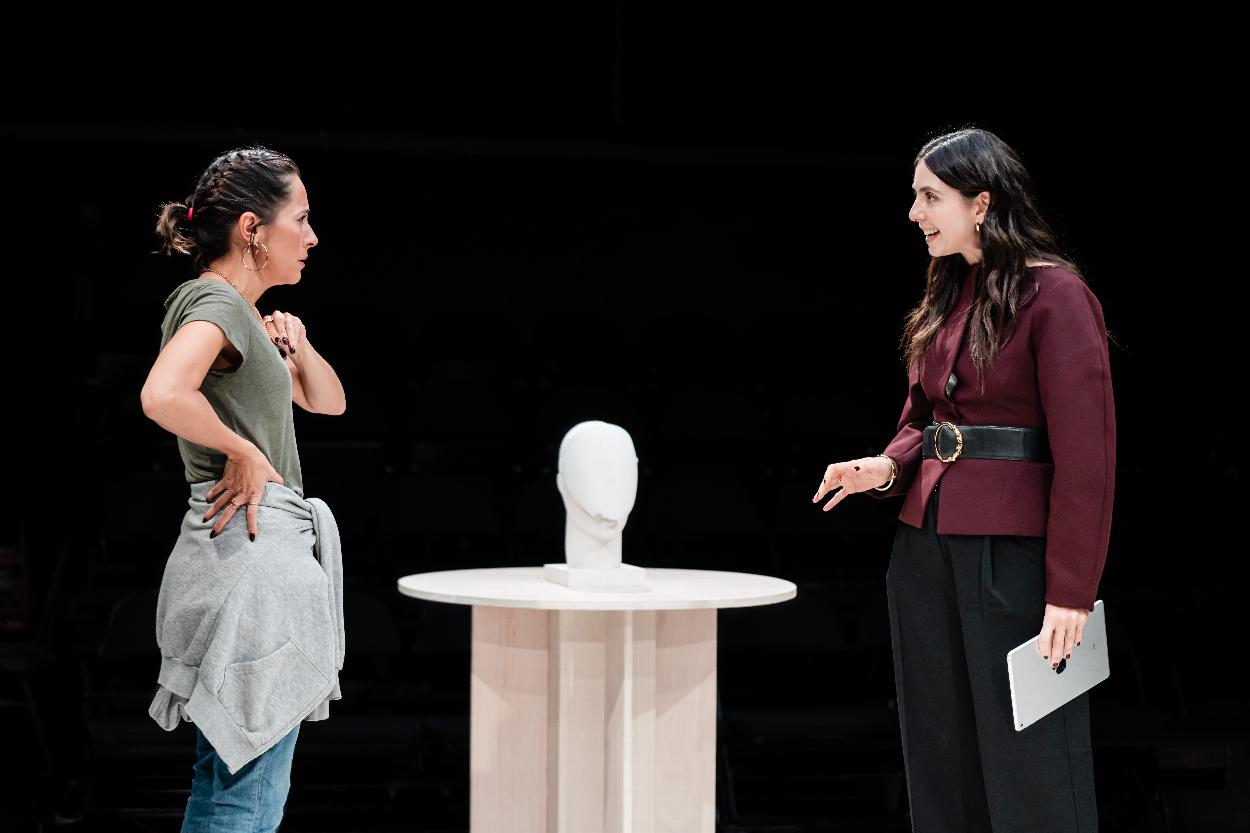
Capturing familial memories – even ones markedly less historically important than the ones at issue in this play – was a central concern for me during Covid (and one that I need to go back to). All too aware of my grandmother's generation passing – and with it their stories and histories - I did try and set up a rudimentary system whereby memories of family members passed could be recorded and preserved. As such, I was all too aware of the initial impetus that Rachel (Rachel Barry, carrying much of the narrative exposition in both the corporate and family settings), granddaughter and employee of Memoriam, a far more sophisticated outfit when it comes to harvesting, preserving and, crucially for the drama that unfolds, editing memories large and small, brings to the story.
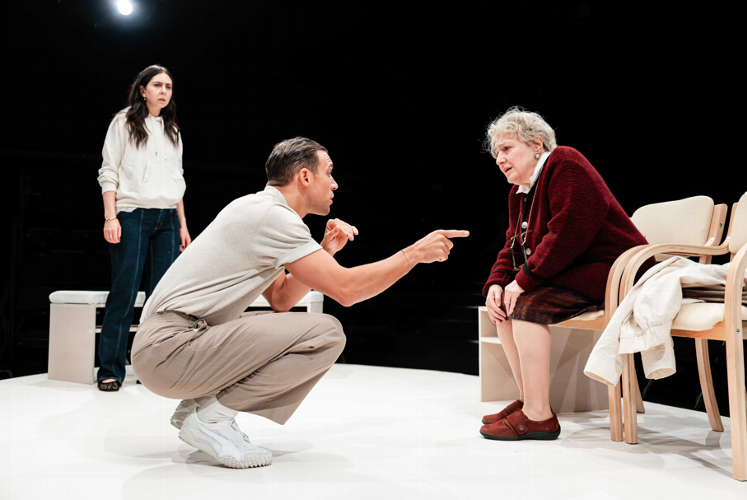
The bigger issues considered here – revolving around the unique importance of the Holocaust as a historical lesson to all – are significant and sensitive, increasingly so in an age where antisemitism is sadly on the rise once again. One only needs to look at the recent travails of both the Corbyn Labour Party and Zach Polanski's Green Party to see the struggle to balance the historical atrocities done to the Jewish people with the behaviour of the Israeli government at times. As such, this play is timely, revolving around the need to capture the memories of the last Holocaust survivor, Rachel's grandmother, Rivka (Beverley Klein, staying the right side of stereotype and injecting much warmth and wit into her handling both of her warring grandchildren and the corporate behemoth of Memoriam, represented with superficial sincerity by Ben Wiggins' oily but effective supervisor, Chris). The uniqueness of the moment presents both a golden commercial opportunity for the company, but also, ironically, is the reason why such moments should not be placed in their hands, given how they would seek to present and preserve them for posterity.
That is not even a central concern for the other protagonist in the story, Ashley Margolis' David, brother of Rachel and loyal defender of his grandmother. He is horrified at the very idea of harvesting these memories, even with the sums of money being bandied about, without having to know about the wider editing process that Memoriam will insist on, in order to provide narrative order to the chaotic collection of painful remembrances of family lost (Rivka's parents and her sister, Sarah, who had dedicated her life to the cultural and community importance of remembrance – the tension between history as either education or entertainment is explored well here). The advantage for David, as grandson and father, is that he already knows Rivka's specific memories (there are, of course, already plenty of sources available, although the many books on this subject are amusingly dismissed by Chris with the worrying comment ‘Books? Who reads?!'). Already under pressure at work to deliver this ‘asset', this added a further dimension to Rachel's dilemma and, while I did not get all of the Jewish jokes, I fully grasped the convincing sibling dynamic, with grown adults with responsible positions rapidly descending to childish name-calling and, briefly, fighting (hair is pulled at one stage).
If I had a criticism, it would be that the show as written – by Noga Flaishon – does not seem to fully have the confidence in the central familial narrative that I had. I felt it was strong enough on its own – in a relatively brisk running time of 1 hour 45 minutes without interval – and did not need the additional subplots, even including the discovery of a historical Nazi memory on their books. The initial harvesting of Becky's (Jimena Larraguivel) childbirth memories was there to allow Rachel – Basil Exposition style, to quote Austin Powers – to explain the Memoriam process to the audience (as an experienced executive and diver, she would not need to go through the technicalities again in her blandly reassuring way). However, the demeaning editing process – done to make the memory more palatable and positive for a wider audience – was covered later in the play in the far more effective clash over the contract between a wily Rivka and Chris, straining to be sincere at all times. In that sense, Becky's issues felt a little surplus to requirements, taking time away from what should be the central focus. Also, a rather clumsy transition – after Rachel has melded memories with her grandmother – left Barry having to leave the stage after writhing in pain; the effective sequence preceding this, done in complete darkness, could simply be extended to allow the actress to depart, leaving it to our imagination the level of damage done by the very process she has insisted on. And, continuing the theme, I felt the show took one final step too many, to wrap up the squabbling sibling dimension of the story; no offence to Margolis, who was effectively spiky in his role, but the play could and arguably should have ended with the central relationship between the two women, with Rivka's initial memories – a beautiful monologue from Klein – and Rachel beginning to learn her grandmother's story the old-fashioned way.
These are ultimately minor criticisms, artistic choices that are always up for debate in any production. This show is timely, not only in its subject matter – with much to say about the past, how it is represented in the present (Hollywood took a brief bashing with Spielberg mentioned and Rivka lobbying for Meryl Streep to play her in Memoriam's presentation – it also allowed for a neat observation about whether Jewish roles should be played by Jewish actors, a recent controversy for Helen Mirren, cast as Golda Meir) and the future, given the AI technology required for Memoriam to function. Thought-provoking theatre such as this remains sadly the exception to a general rule, particularly in the West End, so, if you want to be both educated and entertained, consider spending some time watching this family decide whether it is right to walk down memory lane.
It runs until 21 November.
Review: David Brown Photos: Charlie Flint Photography