
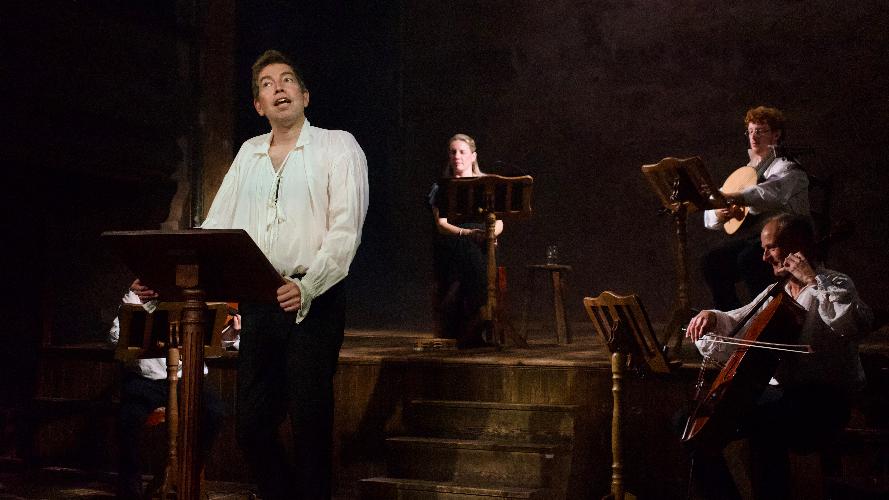
Diaries serve multiple purposes (I should know, because I have kept a monthly journal since 1998). They can be a silent sounding board, a place to file all of the frustrations of the day or a mechanism for defence or distraction (in a far more serious context, the diaries of Nazi doctors working in the camps were used as a mechanism to impose a banal ‘normality’ to the horrendous practices they were engaged in, with their daily records full of detailed description of meals and other fripperies, alongside the occasional chilling mention of ‘procedures’). They can be used to shape a more positive narrative, at least for an audience of one. Or, in Samuel Pepys case, they are penned with posterity in mind, as his final request-cum-bequest to Magdalen College makes all too clear.
Which brings us to the show, a mixture of extracts from the many volumes of Pepys’ diaries, brought to life by Edward Bennett, a familiar face from stage and screen, and a talented group of musicians, led by lutist Daniel Murphy – and including violinist David Le Page (who was also the musical director, and therefore largely responsible for the arrangement of pieces to accompany and underscore the text) and the aptly named cellist Nick Stringfellow, there to accompany the beautiful voice of Grace Davidson (who also essays Pepys’ long suffering wife, Elizabeth). The show – two hours in length across two acts, including an interval – has a deliberately repetitive structure, words followed by song or the occasional instrumental (there was a hauntingly lovely lute solo in the second act, but I was neither counting nor possess the necessary musical knowledge to identify it from the list of accompanying music). These interludes puncture the occasionally pompous musings of Pepys, who blends the personal with the political, but rarely seems to get the blending in proportion.
There is a second repetition at play in the themes identified and selected for the diary excerpts and here the issue lies with Pepys more than the talented cast. Pepys’ historical significance rests largely on the fact that he witnessed some monumental moments in the history of this country, much of which is covered in the – for me – more focused and interesting second act (this is also where the words and music were fused together most clearly, with London’s Burning sang softly and slowly as Bennett relayed the Great Fire of London; it is also partly why the show has the clever name that it has, both in reference to the blaze and also because ‘diary’ forms a central part of the title). As well as the fire, there is the plague – which has greater resonance given our own more recent brush with the language of lockdowns and the televised counting of the dead on a daily basis - and the continued threat of Dutch invasion, a matter of even greater concern for Pepys, given his central role in the Admiralty (he describes himself as the ‘right arm’ of the navy). What Pepys had to say here was fascinating.
And sadly all too short, relative to the diarised domestic disputes, the endless repetitive descriptions of his meals and grooming routines (there’s a lot of wigs and wine here, as well as a fascination with cheese) and the caustic comments on court politics from a political figure in reality on the periphery for much of the action (not that you would get a real sense of that given both the adulatory absolutes that, Trump like, colour his commentary and the Brandreth-esque ease with which he name-drops the nobility, with Christopher Wren and Nell Gwynn also warranting occasionally witty mentions). Much of the first act was filled this way and sadly too much of the second. While, in Bennett’s capable hands, there is comedy to be mined from this material, it was difficult to warm to a character who has witnessed so much (in the first act, there is the uncertainty of what type of state Britain will be, something we take for granted now, but at the time was a real choice between monarchy and military rule, parliament or Protectorate), but still believes his greatest tragedy was being caught with a servant girl by his already angry wife (who has been cheated on, abused – given a black eye at one point and has been hitting back, literally and metaphorically). His lustful pursuits are worthy of a laugh, but I'm not so sure are worthy of so much of the show.
One final point regarding repetition (and yes, I see the irony of using repeated repetitions as the structure of this review). While this form was not really for me – I would have preferred more shade than light, far happier with the darker but more substantive detail depicted at the start of the second act – to make up for the fact that Pepys has peaked (it was only a two day event), the same producers - Hambletts - and Wilton’s Music Hall have a second offering of a similar nature to tempt people with next month (two shows on November 12th). Anton Lesser, no less, will be presenting Dickens’ festive classic, A Christmas Carol, in a blend of words and music. One for the diary, perhaps?
Review: David Brown Photo: Jack Cooper Stimpson