
This one-woman show, edited by the late, great Alan Rickman and journalist Katherine Viner, draws from the journals, emails, and letters of Rachel Corrie, an American activist who was killed in Gaza in March 2003 at the age of 23.
Using only her own words, we are taken on her journey through childhood, adolescence, and adulthood, as well as her aspirations to be a writer, Spider-Man, activist, and more.
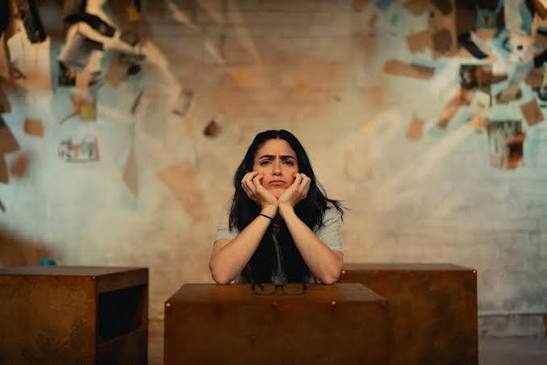
As we enter, Cassie Bradley is already on set as Rachel, sitting in a room adorned with paper, postcards, and symbols of the early 2000s while smoking and painting her nails. Set designer Jana Lakatos has thoughtfully and imaginatively used this small space. We are transported from the place of Rachel's birth in Olympia, Washington, to Russia and then the Middle East through the clever lighting of different areas of the set designed by Liv Baldock.
We are speedily taken from Rachel in fifth grade to her arrival in Rafah through diary entries and letters. It happens perhaps too quickly, causing us to miss some of her motivation for wanting to go to the Middle East. However, there is no denying that she was a talented writer, and Bradley’s performance is consistent and strong, which, with just her on stage for 90 minutes, is to be applauded.
This deeply personal journey sees her writing on walls to convey what her work and mission involve. With every word etched, she becomes physically dirtier, reflecting the trajectory of the conflict she is trying to stop.
Tension builds, though not as tightly as it could, as she learns of the horrors of 9/11 and its global impact. The script tries to portray her increasing frustration, fear, and her parents' worries about her being in Gaza. Be it due to pacing or the lack of another voice on stage, it does not quite peak in the way it could. That said, the audience was captivated.
I desperately wanted to be moved by this incredible true story of a determined, brave, and strong woman who would be the same age as me, and whose life made me reflect on what I was doing at 23. There is much to admire here, Rachel's own words are vivid, funny, and searching. Yet, I found myself only truly moved when Rachel leaves the stage and we read an eyewitness account of her tragic and unnecessary death, followed by a video of her as a child championing understanding, love, and support for children less fortunate than herself.
Those closing moments carried an emotional weight that the preceding scenes, for all their craft, did not quite build towards. It left me wondering whether a little more context about the wider political situation, a stronger sense of her relationships with the people around her, and some further use of multimedia might have made for a more memorable evening. Even so, the audience was clearly engaged, and this is a production that will give many people a way into Rachel's story. One thing is for sure: her voice is as relevant now as it was in 2003, and it deserves to be heard.
It runs until 17th October.
Review: Sara Newman Photo: Chewboy Ross Kernahan