
Some years back, my mother and my aunt had a disagreement over their respective marriages (this may seem like an odd way to begin a review of what is a homoerotic two-hander set in early 1980s San Francisco, but bear with me…). My aunt argued that she knew her prospective husband better as a result of the letters they exchanged while he was away in the Air Force than my mother did with my father, while they spent their courtship in the same town. Both couples were married for over fifty years and so, while I am clearly biased in favour of my parents, I can see my aunt’s point. You do not have to be co-located to get close to someone; in fact, as this play suggests, it may actually be easier to connect telephonically and, given the context of this period piece, written and premiered 40 years ago in America, safer to do so as well.
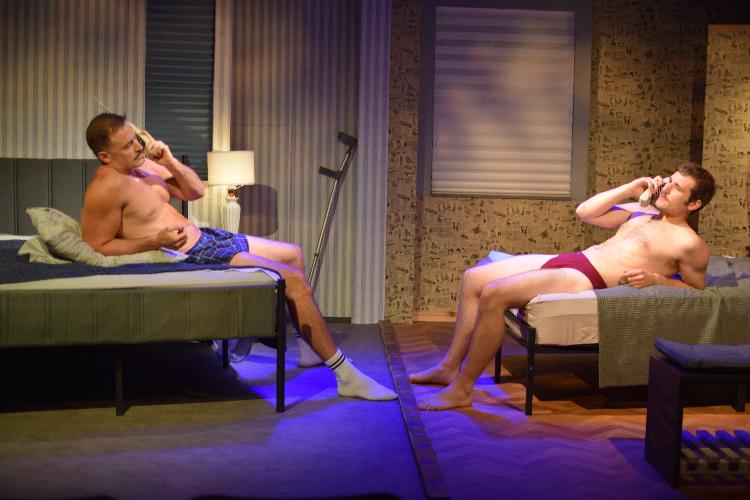
And yet, even as I write that, it does not fully capture the essence – or indeed even the narrative - of this play, because this is about the lengths two men will go both to connect and not connect at the same time, to be both liberated by the play’s situation and limited by it (all of the brisk 90 minute running time takes place on one set – a tale of two bedrooms, if you will – with the two protagonists, JR – Paul Dennison – and Bert – James Lee – facing each other on separate beds, but never actually literally in the same space at the same time). This could be an issue – how do you stage a play charting the budding roots of a new relationship while both characters never meet and would arguably deny that this is what was happening? (even Meg Ryan and Tom Hanks met at the end of Sleepless in Seattle) And yet, the repetitious structure of the play – a series of calls, most if not all initiated by JR, some short (and funny – there is an early encounter that ends when only one man is satisfied), some longer, more intimate, as fantasy mixes with reality and the emotional connection deepens – works well here, variety injected into a structure where both literally nothing happens and everything is happening, all at the same time.
Do not be put off by the explicit nature of the play – this is a homoerotic love story, less about anatomy (although both actors are understandably naked or semi-naked for the entire show – and are both rather easy on the eye as physical specimens) and more about affinity and affection. Sex is merely the hard outer shell that both men must penetrate to reach something more rewarding; it is a means of discourse to take both to a deeper level. And, while the end is entirely predictable, given the period the play is set in – the occasionally silent shadow of AIDS hangs over all of their exchanges – it is no less poignant, with Dennison handling well the plaintive plea that moves from unspoken to unanswered.
This is a play – ironically given the setting – with multiple layers. It is about power, both between the two men, setting up a Silence of the Lambs-esque (stay with me, it will make sense) queer quid pro quo, as they move from physical encounters (sort of) to emotional intimacy, and power over a virus that hovers outside their bedroom walls, waiting for its moment. In the power battle between them, a neat use of childhood metaphors underlines the transition, starting as fantasy fetish but ending as comforting bedtime story. Demands are made but not always satisfied – the advantage of the anonymity that both seem to claim they want at the outset (JR has a lovely speech about the ‘anonymous relationship’, a central conceit of the play) – and power shifts playfully between them. It is about the stark realities of what gay life used to be like – but thankfully need not be now – but it is also about the human condition, the need for connection whether you think you do or not (both actors do an excellent job of conveying a rapport without being able to physically interact). And it is about living your life as you want to, regardless of how others may view it or judge it. This is homoeroticism with a heart.
The actors are aided by two other factors worthy of note. As part of the simple but effective set design, we are back in the world of landlines and answer machines, nostalgia for a certain generation in the audience, a new experience for others! They are not just the means of communication; there is a beautifully lit shot towards the end of the show where the answer machine becomes our central focus. And, underscoring the events that are taking place, the soundtrack for the show – kudos to the director, Henry Adams, and his sound design partner, Scott Michaels – was spot on, both perfect for the period and conveying timely messages about the events.
It runs until 18 October.
Review: David Brown Photo: Scott Michaels