
When I was growing up – which was admittedly some time ago – sport, particularly professional football, and the gay community seemed worlds apart, a Venn diagram that barely touched (and, as the treatment of the likes of Justin Fashanu, one of the first to come out as gay although after he retired from the game, a trend that has continued to the present day, and Graeme Le Saux, famously labelled as gay because he was one of the few professional footballers who openly admitted to reading The Guardian, showed, when the connection was made it was hardly a positive one). The situation has thankfully changed, both in the sporting world generally – think for example of Tom Daley – and in wider popular culture. You only need to consider the 2026 TV phenomenon that is ‘Heated Rivalry’, a Canadian show about gay ice hockey players – which came from a whole series of books about the same characters by Rachel Reid and which has already spawned three parody versions of the show, two of which, one with the same title and Deep Heat Rivalry, are on or are about to start in London soon – to see the two worlds overlapping in a more obvious way.
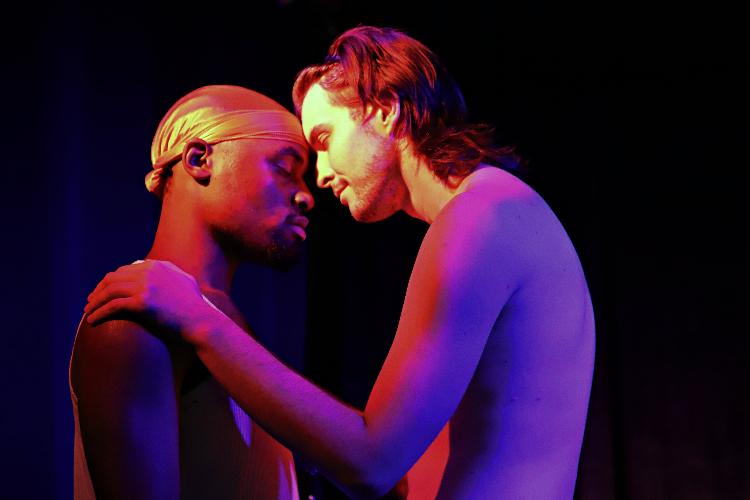
Which brings us to ‘The Pass’, a celebrated play by John Donnelly, which has already been made into an acclaimed movie a few years ago, starring Russell Tovey, and is revived to good effect at the Pearly Queen Theatre in Bow. Unlike the ice hockey options – which are, admittedly, parodies – this is a more serious and therefore more substantive offering, a Faustian bargain in football kit, led by the increasingly impressive Ben Moxon as Jason, an omnipresent figure on the small stage, advancing in his career, but not really moving on in life (as represented by the fact that all three acts take place in different, but essentially similar, hotel rooms, as if his world has both opened up and closed down at the same time). At the start, rooming with fellow novice Ade – a more serious, as required, Josh Hitchman-Pinnock – they both brim with ambition and optimism, although, as Ade notes towards the end of a frenetic first act, there will only be a place on the team for one of them. This is the first game – the game of football itself – and a crucial moment in said game sends their lives spinning in very different directions, although – when they are united in the third and final act - it is far from clear that either man is truly happy. If there are winners here – and it very much depends on what you measure as important in life more generally – it is not immediately clear cut who has triumphed.
There are not just passes taking place on the pitch. This play is about the wider game that closeted gay sportsmen have to play off it as well, with the increasingly self-imposed societal conventions eventually constricting the successful and far wealthier Jason more than Ade (while his final speech may feel a little too ‘on message’, it does contain an essential truth, the character having been shocked back to his senses after a drunken, drug fuelled denouement ended with Jason’s dangerous treatment of poor Harry – Charlie Hammerson – less of a character and more of a catalyst for Ade to see sense, although armed with two excruciatingly funny speeches that show he also is trying to play games with his celebrated client in his own way). In the first act, we see the cruel contradictions of the sporting world – while you stay on the right side of the line, you can engage in all sorts of physical tomfoolery, with Ade and Jason constantly touching each other but in a ‘manly’ way, as part of a mock fight or locker room banter (with a touch of perceived racism thrown in, from references to slaves to Jason’s cancel-worthy blackface with a jar of Nutella). Any gay man of a certain age, who has memories of PE class, will recognise this phenomenon – the gayer you act, by grappling with other boys, the more straight you will be seen to be. Gay insults abound, the night progresses and a line is effectively crossed (though this is done off stage, more erotic than explicit, allowing for more studied ambiguity until revelations abound in the final act). This is the second meaning of pass, a different game being played and one that Jason will have to contend with, with the help of lawyers, for the remainder of his career.
The final character of note is Lyndsey, played with verve by Eliza Shea, adding a dash of humour to the proceedings and challenging the macho culture established in the first act as a feisty femme fatale with her own game to play. The battle of wits between her and Moxon is a particular treat, as we see the lengths Jason is willing to go to protect a multimillion pound image (in footballing terms, this ultimately proves to be his set piece, to add to the collection that impresses wannabes like Harry and keeps him in both the public’s eye, but also that of Ade, who he clearly still wants to impress and potentially control). While behaving increasingly erratically at the end, when reunited with the one that got away, there are also quieter moments of self-reflection that break through the bravado and add further nuance to Moxon’s performance. It also has to be said that the video imagery playing at the back of the small stage and noted in the programme, which is supposed to chart Jason’s inner turmoil, was lost on me at the start (I noticed it after my attention was drawn to it); however, this may have been due to the presence of Moxon, who is rather easy on the eye and was sat on stage awaiting the audience, clad in sunglasses and kimono! (in the interests of balance, both the leading men are handsome, making a nice physical contrast in both size and look)
There is much to appreciate and enjoy in this timely tale – so do not let the opportunity pass. Make the journey to the historic Bow Bells, with the theatre upstairs (while the karaoke from the pub sometimes creeps in, though on the evening it seemed to be adding its own gay soundtrack at times, compensation can easily be found with the excellent Mexican menu – as well as the tasty fayre being offered on stage). If you are a sports fan, a fan of queer drama or of quality drama generally, driven by character fuelled conflict, there is something for you in this more adult exploration of a still frustrating phenomenon – startlingly, in 2026, there are still no openly gay footballers in the Premier League.
FIVE STARS
It runs until 3 October 2026.
Review: David Brown