
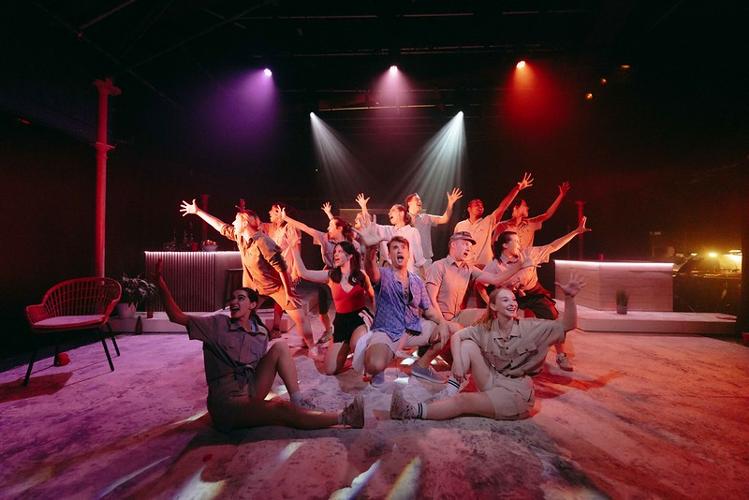
Shakespeare’s Love’s Labour’s Lost has always been a challenge to stage well. The plot is at times ridiculous, the language dense and its collection of eccentric secondary characters can distract from the central story. Over the years, we have seen productions experiment with settings ranging from a Hollywood studio to Ibiza to a tech-bro island. This musical adaptation takes another route, relocating the action to the aftermath of a US university reunion – an engaging way into the story which SEDOS exploits from the moment the audience arrives, as partying alumni mingle among us over drinks.
Owen Thomas James’s direction of this Alex Timbers and Michael Frieman musical establishes an infectious sense of fun which rarely lets up. They take the inherent absurdity of Shakespeare’s premise – four men making an elaborate vow to devote themselves to study and avoid women, only to abandon it almost immediately – and run with it. The men are gloriously ridiculous and their discomfort as their grand intentions unravel provides some of the evening’s biggest laughs.
There is, however, a price to pay for all this exuberance. Love’s Labour’s Lost has always been a play whose subtler ideas risk disappearing beneath its silliness, and the musical amplifies that tendency. Shakespeare’s fascination with language – verbal showing-off, wordplay and the use of eloquence to disguise rather more basic desires – does not find an equivalent in Michael Friedman’s songs. The lyrics offer occasional insights and Shakespearean in-jokes, but can also be clunky and simplistic, sometimes over-explaining what the audience already understands. The songs certainly make the story more accessible, but do not always deepen our understanding of it.
Instead, we romp entertainingly through a succession of musical genres, sometimes rather jarringly, accompanied by increasingly energetic physical comedy. Mia Mann’s choreography is superbly executed, fresh and witty, with a boyband-inspired number proving a particular highlight. Maria Hallows’ musical direction is similarly accomplished: vocals are confident and beautifully balanced, and the overall musical presentation is so polished that it is easy to forget this is an amateur production.
James marshals all this energy impressively. Mickey Dimitrova’s set, realised by Stuart Massey, creates multiple playing spaces without cluttering the stage, while Ruth Luckins’ lighting, Adam Coppard and Adam Lockett’s sound and Annie Houseago’s colourful costumes contribute to a production of considerable technical assurance.
Arthur James Page makes an engaging King, while Alex Stephenson’s Berowne combines wit, scepticism and excellent comic timing. Edward Horrocks and Joby Blair complete the quartet effectively as Dumaine and Longaville. Their collective pomposity, panic and romantic ineptitude are consistently entertaining.
The women ought, however, to provide more of a counterweight. In Shakespeare’s play the Princess and her companions are not merely romantic prizes: they repeatedly outwit the men and ultimately dictate the terms on which their relationships might proceed. Here they feel somewhat secondary to the men’s antics and, particularly within the university setting, occasionally come across more as irritating sorority girls than the intelligent women who should have the upper hand. Anna Colless, Rachel Clements, Emma Miller and Izzi Richardson nevertheless bring plenty of energy as the Princess, Rosaline, Maria and Katherine respectively.
The supporting characters provide some of the broadest comedy. Alvaro Blecua’s gloriously absurd Don Armado makes an unforgettable entrance best left unspoiled, while Jess Treacy’s Moth, Beth Dickson’s Jaquenetta and Taylor Hooper’s Costard make strong contributions. Mark Siddall, Rob Wallis and Emma J Leaver also prove a hugely entertaining comic combination as Dull, Holofernes and Nathaniel.
The difficulty comes when the production needs to find something beneath the fun. The men’s eventual reconsideration of learning, love and the value of promises feels less like the culmination of a journey than something added because the story requires it. A penultimate ensemble number, complete with new costumes, even has something of the awkward final minutes of a pantomime in which everyone reappears to assure us that all’s well.
That perhaps encapsulates both the strength and limitation of this Love’s Labour’s Lost. SEDOS delivers the musical with tremendous skill, commitment and imagination. It is colourful, physical, frequently hilarious and enormous fun. But in making Shakespeare’s already exuberant comedy even more exuberant, some of the elegance, wit and bittersweetness of the original becomes lost amidst the party.
As a production, it is exceptionally well executed. As an adaptation, it makes Shakespeare considerably easier to enjoy – but not necessarily easier to understand.
SEDOS Love’s Labour’s Lost plays at the Bridewell Theatre from 15th-19th September 2026.
Review: Jason Lane Photo: Maggie Zhu