
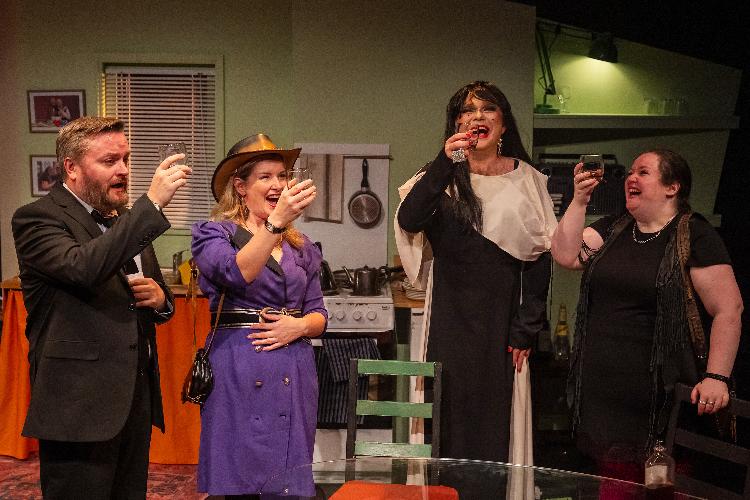
Mammy’s House aims to educate its audience on Irish and LGBTQ+ history. This focus on historical accuracy often stifles the script, and the characterisation suffers as the cast become embodiments of the show’s research, rather than fully realised people.
Set in 1980s London, the conversation revolves around HIV/AIDS and LGBTQ+ from the perspective of the Irish community. The events that take place, including the emergence of HIV/AIDS in New York, fundraising at The Black Cap, and the solidarity between lesbians and gay men all get woven into the narrative, forming a vibrant quilt of history.
However, the script occasionally assumes audience knowledge, one example being references to Irish laundry houses. To be truly informative, the show must ask the question: will a modern London audience understand these contexts?
Where the show excels is in its moments of humour. Nellie (Conor O’Dwyer) is initially presented almost as a caricature of a gay man: he’s overly sexual, he likes to go out dragged up, and he wants to make the world sparkle with glitter. His teasing of the secret lesbian relationship and his sparkly condoms add much needed light to an otherwise dark show. It is this light that breathes authenticity and breaks up the didactic play.
The journey Nellie takes throughout the show from naïve to afflicted mirrors the audience’s own learning curve, and his final letter is where the show feels like it reaches a natural and joyful conclusion.
The other key theme is guilt, which is hammered into us in what feels like a slightly unnecessary extended ending. Mammy/Barry (Derek Murphy) finally stops carrying his cross and moves on with his life, symbolised by buying a dishwasher, as Nellie suggests at the start of the play, and welcoming new people who need support into the house.
Murphy delivers a genuinely emotional performance, particularly in the shared moment with Nellie on the sofa as they reconcile their differences.
The heroes of the show are of course the lesbians (Mags and Sally) who are presented (and rightly so) as the champions of the community. Their backstories are explored, they have heart-to-hearts, and they even get their happy ending.
There’s beautiful dialogue when Mags (Jemma Curran) describes her first love to Sally (Ciara Pouncett) as having “freckles like constellations”. However, even their scenes fall into the trap of being one-sided conversations in their attempt to educate. After Mags and Sally have been tending to Nellie, Sally delivers a long monologue and Mags is given one question to ask, and then at the end is given one further short line. The problem isn’t this scene in isolation, rather it’s how often this happens because it causes the show to lose its pace.
The set changes also disrupt the rhythm as they drag on. The scene change after Christmas Day is agonisingly slow, and later in the show the audience is left in silence for another long scene change.
Upstairs at The Gatehouse is a good choice for a show based around an intimate story. The set and the props help to support the narrative, such as the art project that is initially an inconvenience on the table becoming a part of the colourful wall display that shows growth and pride in the community.
Unfortunately, the interval entertainment misses the mark. The drag queen (Stephen Cheriton) is put in an ill-fitting dress and attempts to entertain you whilse you order your ice cream. It’s a great idea, but the jokes were particularly stale.
Mammy’s House is a lovely concept, but the fixed setting means characters often tell the story rather than show the story. More weight could be achieved through flashbacks to show Barry’s relationship with his lost partner Cyril, Shay (Justin Ensor) and his mother reconnecting before he dies. Overall, it’s a solid narrative, and it has a great full-circle moment to conclude the play.
Review: James Dix