
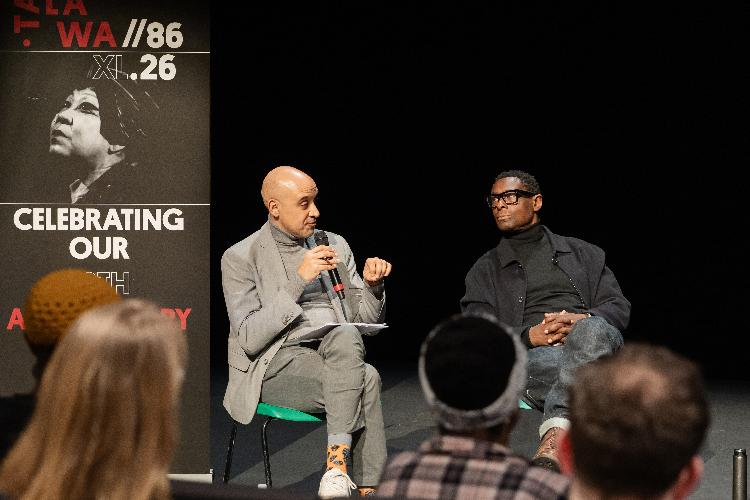
Warm words, deep respect and a collective purpose infused the inaugural Mona Hammond Lecture Series at RADA. The evening was an invitation to honour the remarkable legacy of Mona Hammond, but also contemplate the landscape of opportunity for future generations of artists. An invitation to explore questions - to reflect, to challenge and to imagine - the Series is rooted in RADA and Talawa Arts shared values.
Creative Lives in Changing Times: Well-being and the Artist marked the launch of the Series, putting well-being at the heart of the conversation. Welcoming the audience, Marcus Ryder MBE, Chair of RADA, spoke of a conversation that had begun two years earlier which had led to the evening's central premise: that well-being is not simply an individual responsibility, but a structural one.
Ryder was keen to emphasise that RADA belongs to all of us, reflecting the shared values between RADA and Talawa Arts and their commitment to honouring Mona Hammond's legacy. The lecture series, he suggested, should be a space for reflection — and, ultimately, for imagining and creating a better future for theatre.
David Harewood OBE was invited to deliver the first lecture as a RADA graduate but also an actor whose career embodies much of what sits at the heart of Mona's legacy. The topic was explored with considerable insight by Harewood, who took to the stage with a quotation from Othello: “Rude am I in speech.” He was anything but. His powerful presence and resonant
voice immediately captivated the theatre.
At the heart of Harewood's lecture was a fundamental question: How can young artists survive and thrive, and to what extent should well-being be central not only to sustaining a career, but to sustaining a creative life?
Drawing on Stanislavski's emphasis on truth over artifice, Harewood reflected on the paradox at the heart of acting: that sophisticated pretence requires an extraordinary degree of emotional truth. Actors are asked to be vulnerable, to access difficult emotions and to expose something of themselves, yet training institutions and the industry must also consider how that vulnerability can be protected.
His reflections on Mona Hammond were personal and illuminating. He described her as an extraordinary actor and an “auntie” to a whole generation of Black actors. He recalled the piercing gaze with which she would look at him, scanning his face to gauge whether he was alright and coping. It captured something of Hammond's extraordinary humanity. At a time when Black actors were excluded from the mainstream, she was a shining light. Her presence helped make it possible for others to imagine themselves not only as actors, but as artists with a rightful place in the industry.
Harewood described Hammond as a fierce trailblazer, a woman who told fantastic stories and, through her work and her example, sparked change. Because of her, he suggested, Black British actors could see that they had value.
Harwood acknowledged that today there are now far more platforms through which mental health can be discussed and understood. Yet many of the pressures facing young artists remain. The freelance nature of the profession and continuing financial uncertainty can make a sustainable career difficult to navigate. At the same time, the boundary between the personal and professional has become increasingly porous. Social media means artists are watched, commented upon and discussed almost constantly.
Against this backdrop, there was an urgency to address that well-being cannot remain the burden of the individual. If an actor's training requires them to become vulnerable, then what responsibility does the institution have to help them understand, manage and protect that vulnerability? Good training, the lecture suggested, must prepare artists not only for the craft, but for the reality of the industry they are entering. RADA is responding to this by incorporating well-being training into its training. It is an important recognition of a simple but profound question raised during the evening: Art is good for human well-being — but what is being done for the people who make the art?
No institution can guarantee success. But artists should be able to aspire to a flourishing career, rather than simply surviving from one job to the next. This led naturally to another question: What kind of industry do we want? The invitation to the next generation in the audience was to find their voice, protect it and use it sustain their imagination over their creative life.
The Q&A, led by Amanda Parker, expanded on the themes raised in the lecture, allowing Harewood to offer more personal insights into his experiences and working life. He spoke candidly about times when he had found it difficult to stay in the game and about his own struggles, explored in the documentary Psychosis and Me.
His message was not one of easy answers, but of honesty. Difficult things need to be acknowledged before they become overwhelming. As he urged the audience: don't let the uncomfortable things grow.
The question of what makes performance uniquely human also emerged. AI may be able to generate and replicate content, but it cannot replicate an actor's lived experience — their authenticity, pain, memory and accumulated understanding of being human. It will not replace the human experience of shared humanity.
Ultimately, the inaugural Mona Hammond Lecture felt like the beginning of an ongoing conversation — certainly a place to reflect, challenge and imagine.
We were all encouraged to ‘be more Mona'.
Review: Eliza Jaye