
In the year that marks the centenary of Marilyn Monroe's birth, Who Killed Marilyn? makes some bold promises. Sharleen Cooper Cohen's new play claims to challenge the enduring myths surrounding Monroe and restore her “not as a victim”, but as a woman of “extraordinary intelligence, wit and force”. It even invites us to “question everything” we thought we knew. Unfortunately, this production too often does the opposite.
It begins promisingly, with the media circus following the discovery of Monroe's body evoked through disembodied voices and projected newspaper reports. Then moving backwards through her life, Marilyn revisits encounters with the extraordinary collection of men who populated it: Joe DiMaggio, Arthur Miller, Laurence Olivier, John and Robert Kennedy, psychiatrist Ralph Greenson and figures from organised crime.
Marilyn both participates in these scenes and steps outside them to address us directly. Lighting and sound sharply signal these transitions, allowing her to flirt and confide in the audience before slipping back into her own history. It is a potentially fascinating dramatic device: Marilyn watching Marilyn, perhaps allowing the woman herself to interrogate the legend. Sadly, that intriguing opportunity is largely squandered.
The play frequently feels more like a set of research notes yet to fully fleshed out into a compelling story. Facts are repeatedly placed directly into characters' mouths; information about Monroe's childhood, the Kennedys, the Mafia and American politics result in often stilted and unnatural dialogue.
The fragmented structure compounds the problem. Potentially seismic episodes flash past as reconstructed snapshots, sometimes resembling the dramatised sequences in a true-crime documentary. Even DiMaggio's abusive behaviour is presented with surprisingly little emotional impact. Given the breathtaking cast of characters and events available to draw on, this should be riveting theatre. Sadly, the audience is too often left feeling as though they are hearing a series of encyclopaedia entries.
More fundamentally, Who Killed Marilyn? fails to achieve its own stated purpose. Having promised to liberate Monroe from the familiar victim narrative, we see another portrayal of a woman defined extensively through the men who surround her. Having promised to spotlight her intelligence, wit and force, we see relatively little of Monroe's agency. It is jarring that a play that the audience were told would invite us to question the mythology simply reinforces it.
Pixie Lott certainly looks the part. Luminous in shimmering white, she has considerable stage presence and captures the Marilyn we think we remember: playful, sexy, vulnerable, knowingly flirtatious. She delivers the direct-address passages with dignity and, particularly in her final monologue, genuine force.
Yet this creates another paradox. Lott gives us an accomplished impersonation, but the writing rarely allows it to become much more. The familiar poses, breathiness and mannerisms recur, while the private woman supposedly being reclaimed remains frustratingly elusive. We are told about Monroe's intelligence and ambition more convincingly than we are allowed to experience them.
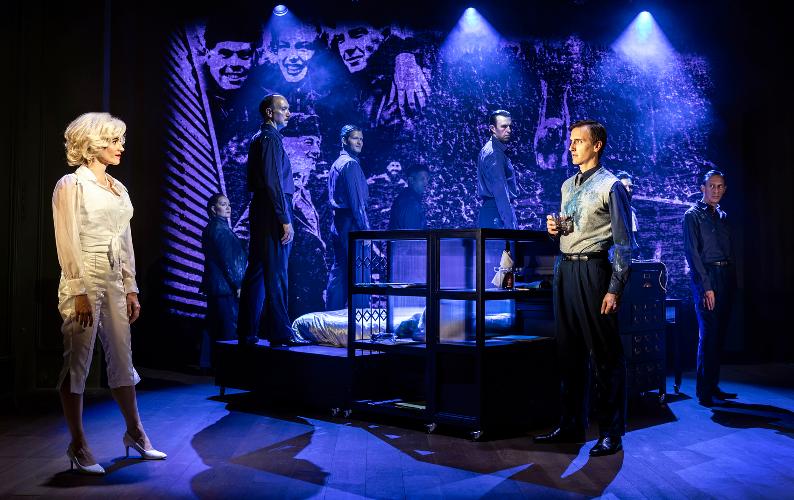
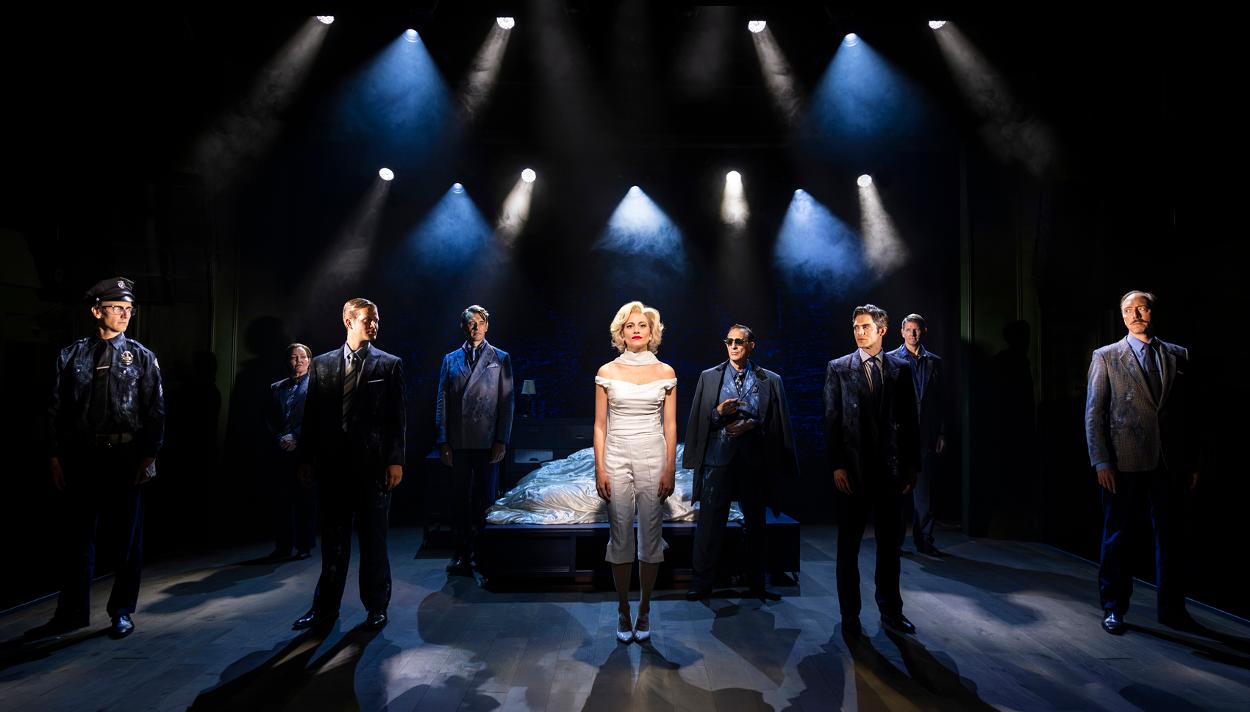
Visually, Philip Wm. McKinley's production is much more assured. Justin Williams' simple revolving set switches effectively between a bed with white satin sheets and adaptable mid-century furniture. Libby Ward's projections create a shifting collage of photographs and newsprint, dominated by atmospheric dark blues and greys. Jasmine Swan echoes these colours in the costumes of the supporting characters, marked by inky splashes while Marilyn gleams in white. It is an intriguing visual conceit, although its meaning remains ambiguous: are these people deliberately being rendered as figures from the background noise of history?
A small ensemble tackles the large supporting cast, with mixed results. Ben Dilloway's Arthur Miller and Paul Kane's Robert Kennedy bring welcome gravitas, Julie Armstrong as housekeeper and charismatic J. Edgar Hoover was excellent, but elsewhere it is disappointing to witness historical figures portrayed so reductively: the lover, the husband, the abuser, the politician, the cartoonish villain. Some wavering American accents do not help, with the gangsters veering into particularly stereotypical territory.
Ryan Ellsworth's Ralph Greenson is saddled with one of the script's least convincing moments. A late therapy scene has Marilyn apparently locating the psychological “hole” inside herself, emptying it of depression and loss, filling it with love and discovering self-acceptance within minutes. It feels glib, anachronistic and unworthy of the psychological complexity the production supposedly wants us to recognise.
Then there is the question posed by the title. The play promises a provocative re-examination of Monroe's death, yet rather than genuinely inviting us to investigate competing possibilities, it advances one conclusion: that she was murdered. Evidence is ultimately delivered to us rather than dramatically interrogated.
Perhaps that does not matter in a work of fiction. But there is an uncomfortable contradiction in claiming to rescue Monroe from the stories imposed upon her while using Monroe herself to authenticate yet another story about her death. Is this finally allowing Marilyn to speak, or using her persona to legitimise a long-held conspiracy theory?
There is considerable potential here. The Emerald Theatre itself, with its reds, greens, velvet and gold and faintly cabaret atmosphere, is an evocative home for the production. The play looks and sounds polished, its central theatrical device is strong, and Lott has the charisma to hold its centre. However, Who Killed Marilyn? feels like a production still in an early iteration. Its book needs greater dramatic focus, its supporting characters need depth, and its considerable research needs to be transformed into drama rather than recited as fact.
Most importantly, it needs to fulfil its own promise. A century after Monroe's birth, we do not need another Marilyn constructed principally through husbands, lovers, powerful men and the mystery of her death. The tantalising prospect here was finally to meet the woman behind all that. Marilyn remains frustratingly out of reach.
Review: Jason Lane Photos: Pamela Raith