
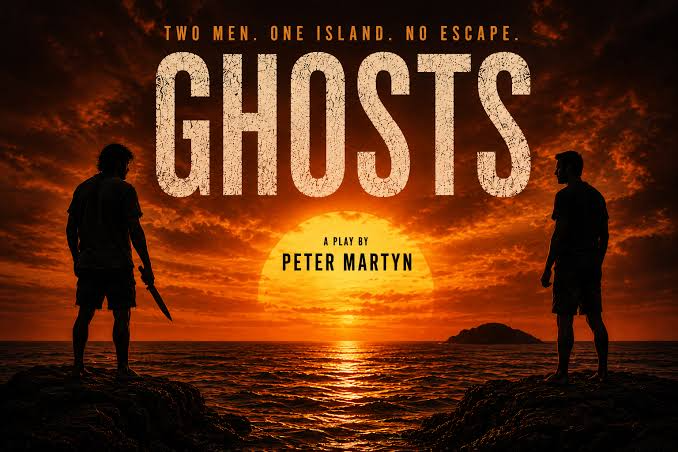
We are met with a man seemingly stranded on an island, going about his daily routine, when he spots a plane that crashes and brings with it an unexpected and unwelcome guest to his world.
Johnny (Nick Turner), a former reality TV star, has in fact chosen isolation on this remote island, and the arrival of Kerrigan (James Turner), a millionaire flying to his private paradise, shatters his silence. Kerrigan is initially adamant about escaping what is, for him, a nightmare. Removed from people, luxuries and money, it quickly becomes clear that leaving is too dangerous and too difficult alone. The pair begin to navigate each other and the work required to survive in isolation.
It takes time for Kerrigan to recognise Johnny from his previous career on reality television, and he is left deflated when he learns that Johnny’s work was not what it seemed. Together they explore the darker underbelly of the genre and the principles of Maslow’s hierarchy, something Kerrigan initially struggles to grasp.
Things take a darker turn when, unsurprisingly for two people forced into proximity, they fight, and Johnny begins to consider how he might return to his solitude, in moments reminiscent of Lord of the Flies.
Billed as a dark comedy, the production offers some laughs, but the comedic text lacks the commitment and timing needed to realise its full potential.
This 75‑minute play uses a series of blackouts to allow for small scene changes and, one supposes, to suggest the passing of time. For such a short piece, however, these interruptions disrupt the flow of the story and hinder character development. For the first hour, neither character is afforded real depth; they begin as selfish, self‑centred men who know exactly what they want. In the final fifteen minutes, a cluster of revelations renders them more likeable and relatable, but the shift feels rushed, making the ending seem forced and overly neat. One wonders whether a darker conclusion might have been more satisfying.
It is difficult to determine what lesson we are meant to take from the play. Is it asking us to reflect on what we truly need to survive? To consider relationships, empathy, and the dangers of judging a book by its cover? To question what redemption actually means? The premise is compelling, but the execution ultimately fails to deliver the impact it promises.
Review: S. Newman