
You do not need to know much about Pyotr Ilyich Tchaikovsky to be completely drawn into Tchaikovsky: Child of Glass, which makes its UK premiere at Opera Holland Park this summer. Written and directed by Tama Matheson, the music‑drama guides us through the composer's life, exploring not only the works for which he became famous, but the man behind them and the struggles he faced in his career and as a gay man living in 19th‑century Russia.
Matheson also takes on the role of Tchaikovsky and is superb. At times it feels as though you are genuinely getting to know the composer, rather than simply being told his story. We see his passions, relationships, humour and vulnerabilities, but also the fear and conflict that accompanied having to hide such an important part of himself.
The title comes from Tchaikovsky's childhood, when his nanny reportedly called him her “child of glass” because of his sensitivity and fragile nature. It is an image that lingers throughout the performance, before taking on a particularly poignant meaning at the end when the glass finally shatters, marking his death.
It is difficult to watch certain moments without reflecting on the fact that, although Tchaikovsky lived more than a century ago, there are still people in 2026 who feel they must hide their sexuality for fear of rejection or condemnation. This gives parts of his story an uncomfortable relevance today.
At the centre of the stage throughout is pianist and Musical Director Jayson Gillham. As Tchaikovsky's life unfolds around him, Gillham plays the composer's music live, allowing it to become almost another character in the drama. Other composers, including Mozart and Wagner, also appear as we move chronologically through Tchaikovsky's life.
Then there is the dance.
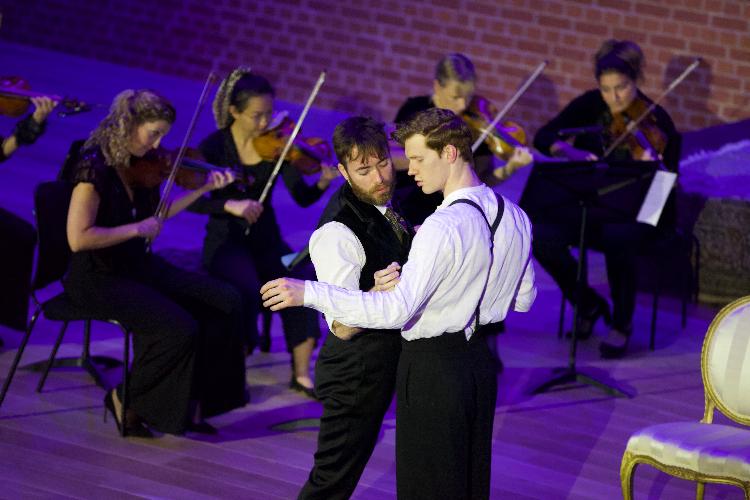
Royal Ballet dancer Téo Dubreuil never speaks, yet communicates so much. Through ballet, he comes to represent Tchaikovsky's lovers, his desires and, at times, what feels like the composer's inner mind. It is a clever way of expressing something Tchaikovsky himself could not always articulate openly. Some of the most affecting moments come simply from watching the two performers together.
Oliver Holland and Suzy Kohane move deftly between the various people who enter and leave Tchaikovsky's life, and both do so with great skill. There are genuinely funny moments too, including flashes of slapstick, which prevent the production from becoming relentlessly heavy given the sadness woven through much of the story.
The stage at Opera Holland Park is impressive in itself. It feels larger than some West End stages, and Stephen Wicks's choreography makes full use of it. Nobody is confined to a small corner of the performance space; the movement across the entire stage gives the production a striking sense of scale. Wicks even makes a well‑deserved cameo appearance towards the end.
It is also worth remembering that this is an outdoor theatre, and the performance took place in the middle of a heatwave. With additional heat from the extensive stage lighting, conditions cannot have been easy. Yet you would never know it from watching the cast. Their energy never falters and there is no hint of discomfort, a testament to the professionalism of everyone on stage.
At well over two hours, this is a long production, but it never truly feels it. The more you learn about Tchaikovsky, the more you want to know. His music, his relationships and his personal struggles build alongside one another.
And then comes the ending.
Without giving too much away, it is beautifully crafted. There is, of course, sadness in reaching the end of Tchaikovsky's life, but that is not what makes it so moving. It is the eloquence of those final moments and the way music, acting and dance converge. It is difficult not to feel emotional watching it.
There were a couple of very slight stumbles over lines, but they were barely noticeable and entirely understandable given the lengthy monologues Matheson delivers, coupled with the intense heat and humidity.
This performance does not separate Tchaikovsky the musical genius from Tchaikovsky the man. Instead, the music becomes intertwined with the parts of himself he could express and those he was forced to conceal.
Matheson, Gillham and Dubreuil create something quite special between them. Music, drama and ballet could easily feel like three separate elements competing for attention, but here they belong together.
Beautifully performed, funny in unexpected places and genuinely moving, Tchaikovsky: Child of Glass leaves you wanting to know more about the man whose music is known around the world, but whose personal story may be far less familiar.
Perhaps the biggest disappointment is that it is only playing for three nights, ending on 15 August. A production this good deserves a longer run and the chance for many more people to see it.
Review: Sunita Jaswal Photo: John Yip