
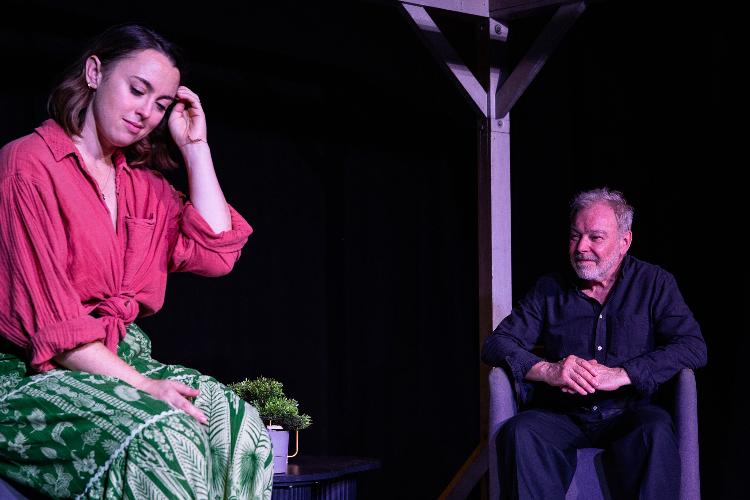
Empty is the debut play from journalist and author Robert Nurden and his own experience of wanting to be a father. The play is based on his 2023 book ‘I Always Wanted To Be A Dad: Men without Children', which investigates the pain of those who never become the parents they long to be.
The play starts with characters David (Paul Kemp) and Amy (Hannah Douglas) on opposite sides of the stage, both with their phones in their hand, replying to presumably the other's message. At this point, we don't know who they are to each other or what is being said. Both then turn to walk off the stage, and the lights dim, before David returns to set a bottle of wine and grapes on the table centre stage.
The play is focused on the reunion of these two characters, who we soon learn used to date. Amy is struggling after three failed rounds of IVF and wants some reassurance from David that life without children is okay. However, things have changed with David, and the choice that once tore them apart might not reflect how he feels now. Throughout the 60-minute production, we weave in and out of the confrontation between the two in David's apartment. However, through the dialogue especially, we learn about other ‘characters' and get a bigger picture of their lives, helping move the plot.
Directed by David Furlong, Empty explores involuntary childlessness and the battles of wanting to have a child, but not being able to either due to infertility or a change of heart further down the line - or not finding the one quite yet. It tackles many topical conversations of IVF, society's questioning of not having children, men's desire to have children, and how choosing parenting is rarely a question for them. We are constantly bouncing between Amy's perspective and David's, seeing the complex and contrasting feelings from both men and women. I have seen a few plays about infertility and childlessness, but they are always centered around a couple, and often more focused on a woman's perspective. I enjoyed the original take here with Empty being about old lovers, and looking further into the male experience of childlessness.
It was interesting how the beams set up on the stage enclosed the setting of the living room. The set was minimalistic too, with the table and two chairs - ideal for a chat or confrontation as such between two exes. The table and chairs didn't move, and instead Amy and David moved around as emotions got tenser. The lighting was also used well to show this tension, with the beams lighting up and the remainder of the room becoming dimmer when one of the characters was delivering more of a monologue, looking out towards the ‘view' (audience) for this.
What let this play down was the unexpected shift at the end with Amy's big question, which I felt was quite suddenly placed in the story. After this, the ending dragged significantly with the two characters very slowly battling over how they will go on and what a world without ever having children will be like for them. This part could have been shortened to create a more dramatic final. I also feel like the text from Jenny near the end would have been better presented as a call from her or a recorded voice message, too.
Overall, Empty is a well-written play that brings about a new perspective on childlessness to the stage. While sometimes the dialogue is a bit drawn out in certain parts, both Douglas and Kemp perform strongly with emotion and humour.
Empty will play at The Drayton Arms Theatre for a strictly limited run from 7–11 July.
Review: Cara-Louise Scott-Lapish Photo: Lucy Hayes