
What is the American Dream? A question asked by many artists over the centuries. Usually, the answer is tinged with sadness and hardship, its subjects always victims of its own hypothesis. In her short story Pushing Up, Karen Russell honours these ideals, conjuring darkness and mingling it with hope. Missy Mazzoli has composed an opera that is vivid, harsh, compelling and unmistakably American, while Royce Vavrek’s libretto gives Russell’s story weight and intrigue.
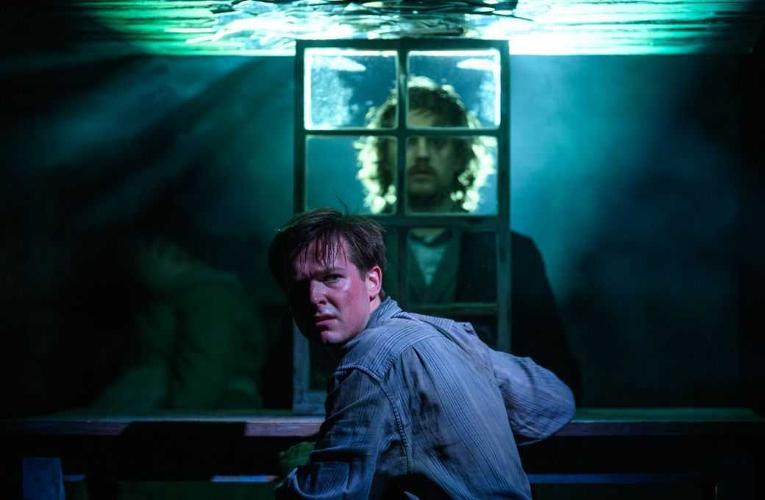
We follow the Zegner family who, in 1870s Nebraska, strive to “prove up” by obtaining the deed to the land they have settled. They have met all the stringent criteria, yet one requirement remains: a glass window to satisfy the demands of the Homestead Act. There are hints of the supernatural, as two deceased, nameless daughters haunt the stage and mock the proceedings. Both sons, Miles and Peter, attempt to secure the sacred window, though many forces work against them. Miles, the central character, navigates his parents — the drunken Johannes ‘Pa’ and the proud Mrs Johannes ‘Ma’ — with careful restraint, determined not to jeopardise the family’s chance. The strange Sodbuster appears to Miles and makes him realise how useless the window truly is, revealing its history and the futility of their Homestead efforts.
There are natural nods to Mark Twain and John Steinbeck. The Wild West seems fashionable again, thanks in part to Cormac McCarthy’s horrifically violent Blood Meridian. I admire the story’s use of illusion and fate; although I found the first half a little lacking, it is after this point that the music and narrative begin to take shape. On several occasions, I found myself drawn to the daring ensemble in the pit, who, in Mazzoli’s score, conjure dust-filled, folk‑inspired hazes. It is striking to see four acoustic guitars and a selection of harmonicas included. Musically, the work both looks back and pushes forward, with many bars executed with fascinating, often shocking experimentation.
I won’t list the singers, as they are still students, but with talent of this calibre, the Guildhall has very little to worry about. One singer encountered some vocal issues, though this can be forgiven. Director Amy Lane guided her cast with fluid movement and helped carve out the roughness of the drama. Designer Anna Yates provided a fairly simple set: a backdrop of what appear to be historical photographs and a handful of homely props that suited the interior scenes. Conductor James Henshaw must have pondered this score with great care, as it is so unusual and curious to hear. Toby Ison’s lighting had moments of flair — the snowstorm and the story’s climactic points dazzled the audience, flooding the stage with concentrated strobes.
In this UK premiere lies an opera that should get people talking, and one that proves the art form never truly went away.
It runs till 8th June.
Review: James Ellis Photo: David Monteith-Hodge