
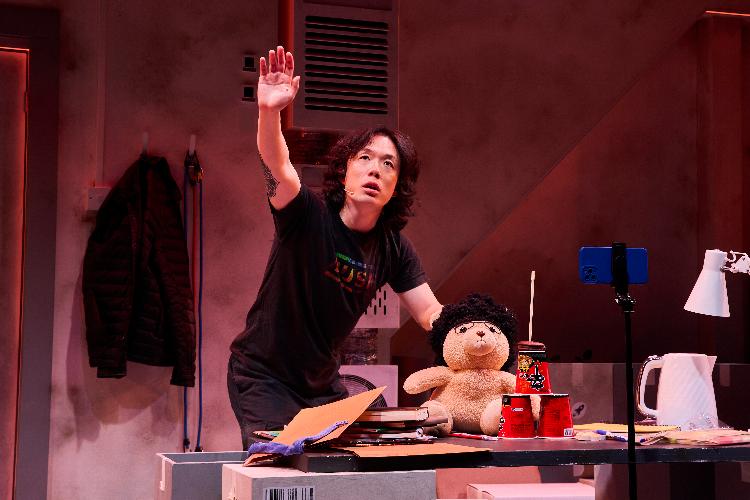
What does it mean to survive? The rock musical that is a cult favourite in Korea has been translated to make its UK debut at the Southwark Playhouse in Elephant.
Lex Lee and Nabi Brown play The Survivor on alternative shows. For the press night, Lex Lee took to the stage. It's a one-person show exploring the premise of a person choosing to lock themselves in a bunker to survive a zombie apocalypse.
The survivor is an unlikeable character who has no personality of their own. They speak only to their phone to vlog their time in the bunker. The vlogs mainly include referencing other movies about people who are isolated, like Castaway or The Martian. It's the same problem people have with cinema and reboots: it feels like there are no new ideas to explore, and the best way to engage an audience is to remind them of something else they liked before. One of the simple and early laughs being based around the fact it is 28 days after his lock in, and therefore 28 Days Later, like the film of the same name.
The vlog is meant to live stream directly from mobile to the screens in the theatre and would have been a great feature if they'd considered, firstly good phone signal and secondly, a tripod that tracked movement. Instead, it freezes constantly, and our lead is confined in movement around the set.
The rest of the show's dialogue includes factual information about calories, marketing speak about products, and the survivor imitating news reports. The character has nothing more to add on a personal note other than having a mother, and an old stuffed bear he can't remember the name of. The show has as much substance as reheated instant noodles. It doesn't fill you up.
The set is seemingly well put together in this underground theatre. But perhaps putting on a rock musical in a small space wasn't the best idea. The rock belt is clear and audible, but the lower range is drowned out by the instruments. The songs are challenging to deliver and Lex Lee does well in his performance of them.
It's fantastic for audiences to be able to experience this show through translation, but there are often lyrics in the show that sound forced. Take the line about ‘I remember the steak' rhyming with the following like about ‘the sauce we used to make'.
Halfway through I contemplated, is this a show about trying to be an adult but failing to grow up and needing to go home where you can be looked after properly? The answer is yes.
Maybe this show resonates with the generation who feel isolated and are struggling to understand the difference between living and surviving. But for many audience members, this will just be a drab set, with a boring wardrobe and nothing new to say.
The premise of the show would work better if there was a reason why the character wanted to survive a zombie apocalypse or a reason why we, as an audience, want them to survive it. Without this, there's a lack of real threat, and there are no stakes. The true theme of the show is mental health and isolation, which of course means that there is no desire to survive, and therefore causes this imbalance.
This isn't the only contradiction in the plot, the character unsure of whether to fix a radio or not makes no sense when we know he's been making vlogs the entire time. Would it not have made better sense if he had more painstakingly questioned whether to call his mother back, or leave the apartment to theoretically save her and therefore his own sanity?
To end this on a high note, Lee does impress with his sustained notes, and as the only person on stage, does well to hold the attention of the audience. When the script allows him to demonstrate emotion, he goes all in to give his best performance possible.
Review: James Dix