
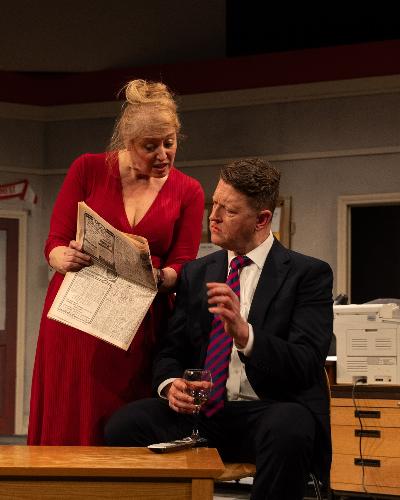
In this election season – and indeed in local election week, how timely! – Questors Theatre have picked a proven winner as part of their latest season. James Graham's work – specialising in dramatising British politics, notably of the 1970s and 1980s – has graced many a stage, with shows such as This House, set in rival Whips offices, and Ink, charting the rise of Rupert Murdoch, while Sherwood was a hit on television. This show – set in a Labour Party constituency office in Nottingham and exploring both the political but also increasingly personal relationships that develop there – shares much of the same heritage, and seeks to answer a question that has troubled many a party leader and occasional Prime Minister – what's Left for the Labour Party?
If this sounds a little esoteric and potentially dry, nothing could be further from the truth. In the safe hands of Ant Foran, as MP David Lyons, and Isabel Barbuk, as his feisty, funny constituency agent, Jean Whittaker, warmth and wit are injected into a structure that Tom Stoppard would be proud of. This is a tale of two people finding a connection in the most unlikely of places, told both backwards – in the first act – and forwards, so we can eventually chart the rise of the Labour Party from the doldrums of the Thatcher era (the woman herself is constantly present as a target on a dartboard) through the New Labour years towards the eventual electoral catastrophe of Jeremy Corbyn, and see how the two acts connect with each other. The first act begins with Lyons, an MP of 27 years in what we are told later is as safe a Labour seat as it comes, from former mining stock, facing a narrow but decisive defeat. The story then reverses in five scenes, back to Neil Kinnock and the beginnings of hope for a particular strand of Labour thinking. Each scene was cleverly introduced with relevant news footage, noting both national and international events, nostalgia for political nerds like myself, and the busy set was shifted in time with both gadgets (laptops replaced by desktops, a fax machine) and posters on the notice board at the back noting shifting signs (the red flag, the red rose) and statemen.
And, with each different character in this eventual political rom-com, Graham is able to identify a different version of the Labour Party, each with its own terminology, ideology and insistence that it is the truer version of the party. This provides some of the political drama, a clash between old(er) and New Labour, as represented by Jean and David, as well as a scheming local councillor, Len (Anthony Curran) and an initially apolitical, naïve volunteer, Margot (Michelle Openibo), who will rise to become Deputy Leader of the Council (but remain touchingly naïve – her innocent reference to herself as a ‘National Socialist' is one of the many witty political jokes contained in the play). Jean is a dyed in the wool socialist, looking to John Prescott as her political lodestar (the 1994 leadership plays a central part in accusations of treachery at the local level), left wing but loyal, unlike her eventual partner, Len, who is a more intellectual socialist, calling out conspiracy and compromise at every turn while organising coups against his own side (he is the Jeremy Corbyn figure). Lyons, with his acerbic and uninterested lawyer wife, Elizabeth (Victoria Smith, doing well with quite an unpleasant character, whose default seems to be sarcasm and sneer), represent New Labour and Tony Blair (a name rarely mentioned in Labour circles these days), seeking to fit in locally as they change the party nationally. As the story flashes back and forward, they clash, cooperate – in a lovely farcical scene that Michael Frayn would have been proud of, set just after Christmas, as shaving foam is sprayed amidst the tinsel and a dying Christmas tree – and become more than colleagues. The eventual romance between Jean and David was cheering if at times a little contrived – the mirroring message on the white board was a case in point – but it was satisfying to see them united at the end (even if the moment on the night was spoiled a little by a premature lighting change).
The play not only had a lot to say about the changing character and fortunes of the Labour Party, but also about the state of democracy itself (it's all about dog shit, seemingly). Local government, the relationship between the party members, its MP and the voters – very cleverly explained in the first act of the second half, as we move back through the same era, this time from 1990 to 2017 – and even the impact of globalisation (the play is set amidst the backdrop of a mining community seeking a new role in the modern economy) are touched on and complimented by the more complex personal drama that is unfolding. There were a few slips – some names were confused – but, given the centrality of the two leads and the wordiness of the play, this is to be expected (there also, a la Michael Frayn, seemed to be a missing prop at one point – red roses in a wellington boot – but this was very cleverly covered by Anthony Curran, as it was central to the personal drama developing). All in all, this was an entertaining evening, particularly for the politically minded, but also for those of a more romantic bent. It is a play that asks important questions – what is the core vote for the Labour Party, as the traditional Northern working class diminish? This week, as Zach Polanski's Green Party and Nigel Farage's Reform are likely to do well across the country, it is another troubling question for Prime Minister Starmer to contend with. He should take time out and hurry along to Questors – he might not find all the answers, but he will be guaranteed a good laugh.
It runs until 9 May.
Review: David Brown Photo: Robert Vass