
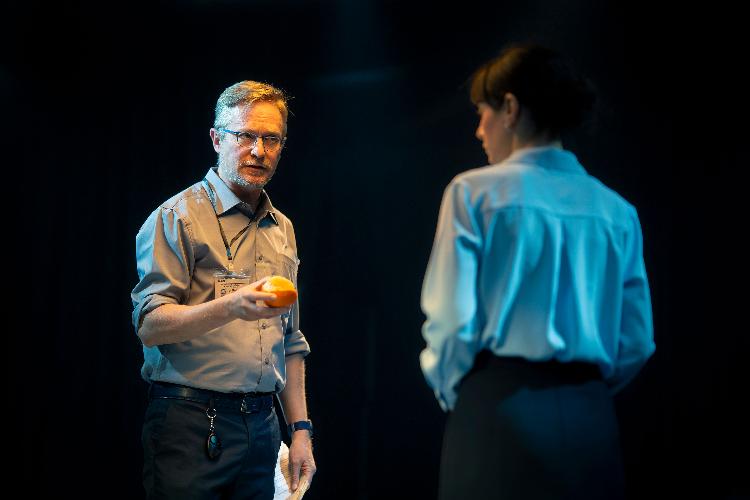
Blue/Orange is a three-person play set over one day in a psychiatric ward. Using brilliant satire, it explores institutional racism, mental health, and medical power within the NHS, and how these can collide in clinical decision-making.
The play tells the story of a 24-year-old Christopher (Andre Bullock), a psychiatric patient who wants to get out but still believes that oranges are blue. His junior psychiatrist, Dr Flaherty (Muireann Gallen), is convinced Christopher is mentally ill and needs to stay in the hospital. However, the senior consultant, Dr Smith (Ciaran Corsar), believes that because Christopher is a Black patient, his way of thinking is all a matter of culture, and he should be released back home. Tensions and strong themes of race, madness, and medical ethics collide sporadically, as the characters fight against eachother for what they believe is right for Christopher.
Blue/Orange is a olivier award winning modern classic play by Joe Pennall, first performed in the Cotteslow auditorium of the Royal National Theatre, London, in 2000. In collaboration with Pennall himself, this Barnes OSO Arts Centre production has been revived 26 years on, and reimagines the junior psychiatrist as a young woman. Originally performed with a cast of three men, Director Lydia Sax has advised that this change will explore another minority voice in this insitrutional setting where 75% of consultants and doctors were men, but also provides a more modern parallel, where female psychiatrists now make up around 50% of the work force. Having not seen the original production, I can't comment on the difference, but it seems to only add to the play's exploration of power and identity, bringing in the power balance of medical male superiors and young female doctors.
Unlike anything I'd watched before, Blue/Orange doesn't shy away from its discussion of race, mental health, and power. With strong language, and a multitude of medical dialect, the play interlaces these themes through the debates between characters Dr Flaherty and Dr Smith, with Christopher being pulled between them, becoming more confused at what he thinks is best for him with the opinions of medical professions being thrown onto him. The dynamic between the characters is interesting, and we get to watch scenes with Christopher one-on-one with each doctor, and also with both, which is effective in building the tension and moving the plot along.
At the forefront of this, the set contains just two blue chairs, and a desk in between, with a bowl of oranges. The lighting is clinical with just a square beam above. It intensifies the consultation room at the heart of the institutional power going on around. With Set designer, Raphae, and lighting and sound designer, Gabriel, Director Lydia Sax, and Producer, Jamie Rycroft, said themselves they opted for the round staging, to evoke the ward's ‘panopticon-style layout'. The clinic blue of the chairs and some of the clothing, creates a contract to the orange of Christopher's belief.
My main criticism of this play was some of the scenes felt somewhat dragged on, which interfered with my ability to keep focus. Especially the scenes between the doctors, it felt like there was too much medical dialect being used and the dramatic back-and-forth dialogue, felt too over-done at points. It would have been interesting to make these scenes shorter, and have more with Christopher, and getting to know more about his mind and background.
However, with these strong debates, it does bring those themes to life, and makes us think as the audience of our own biases and whose side we are on.
Overall, Blue/Orange is an unsettling, much-needed play exploring race, power, and mental illness in a clinical setting. This revived production remains remarkably relevant to today and the actors were all equally sharp and strong in bringing their characters to life.
Blue/Orange will be playing at the OSO Arts Centre in Barnes until 10th May 2026
Review: Cara-Louise Scott-Lapish Photo: Kinga Dulka