
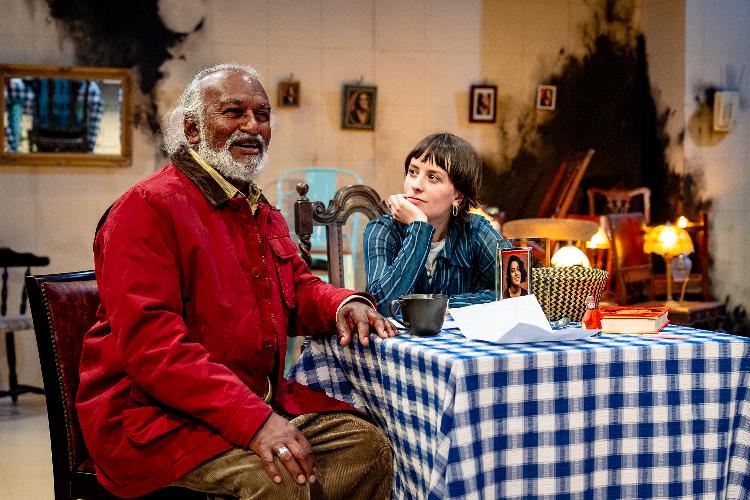
Lucas Closs's new play, The Sequel, is a dark, offbeat comedy that leans fully into its quirks. At the centre of the story is novelist Grace “G.T.”, played by Nisha Emich, who revisits the café where she wrote her first book. Set entirely in a café frozen at the scene of its own literary fame—now reduced to a single surviving table—the production keeps things visually simple and lets the writing and performances do the heavy lifting.
The tone walks a fine line between black comedy and something more reflective, with an intriguing central premise: what happens when real lives are reshaped—and distorted—by someone else's narrative?
Emerging writer Lucas Closs has done a wonderful job crafting a fresh, sharp and confident play, successfully brought to life by director Imy Wyatt Corner. The script is genuinely laugh-out-loud funny, laced with a dry, often biting humour that lands with precision. The many loud laughs from the press night audience are a testament to the success of the piece.
The Sequel features a cast of three, with the standout performance going to Julia Pilkington as café owner Martha. Pilkington's bone-dry, perfectly judged and quietly scathing delivery is excellent. Even when she is not speaking and merely lurking in the background, it is hard to take your eyes off her quirky characterisation—even small eye movements bring a comic element. Jim Findley, who plays John, G.T.'s iconic mentor, should also be commended for his choreography—strange, stylised and genuinely inspired.
The production features a live band, used almost like a film score, largely underscoring the drama and adding texture and suspense to the storytelling. Composer and musician Deniz Dortok's score includes sustained notes which are effective in dramatic moments to heighten the tension and the eeriness of the piece.
The costume design is another excellent layer supporting the quirky comedy. While a visual gag, Martha's clothes go beyond that to demonstrate the cohesiveness of the writing, direction and delivery. The characters and costumes also live on in marzipan form.
The pacing is slick for the most part, keeping the audience engaged across its tight one-act structure. That said, there are moments—particularly towards the end of the piece—where some trimming would sharpen the overall impact.
It is great to see producer Ella Dale taking a chance on a new, distinctive piece of writing, and I look forward to seeing what the winning team of Dale, Closs and Corner do next.
Review: Lola Philips Photo: Steve Gregson