
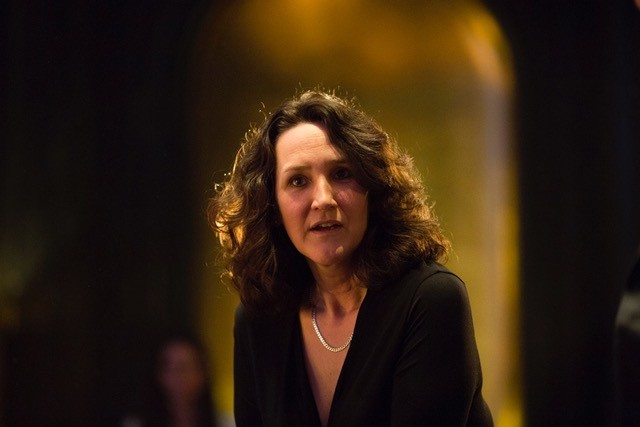
Brought to life by a multi-award-winning creative team, including director Rachel Kavanaugh and choreographer Anthony Van Laast, the big new London production of Cole Porter’s glamorous musical High Society arrives at the Barbican Theatre.
Hi Rachel. Is this your first production at the Barbican?
No, actually I did a show when I was at the RSC, oh gosh, 25 years ago at the Barbican. I worked there both as an assistant director and I directed a show there. So this is a long-awaited return to the Barbican, which I'm very, very excited about. I saw Anything Goes and Kiss Me Kate over the last few years and it is just the best space for a musical like this.
What has been your preparation for this production?
I've known I was going to do this show for approaching a year. And the work began early, I mean primarily going to the Cole Porter Estate and asking if we might be able to change some things, add some songs. And I think partly because of the success of Anything Goes and Kiss Me Kate, they have been incredibly generous with their access to the archives and we've got these six additional songs and that's the prime way in which we make the story richer. Obviously we also have the revisions to the book as well and our whole new concept of the show and new designs all that and but the way in through the Cole Porter Estate and then starting to get this amazing cast on board starting with Helen and then Felicity and then all the other wonderful leading performers and then we did a couple of development days just working on the script but most of it happens in the room here.
Who had the idea to add the additional songs to this production?
That came from me and Howard Panter, the producer, together. Because this show, unlike Kiss Me Kate and Anything Goes, did not begin as a stage musical. It began as a play, then a film, then a film musical. And then the Broadway version wasn't made until the 80s, which this is based on but developed from. So it felt like if we were going to make a definitive version, which I don't feel there has been yet, we needed to have a real examination of what the score might look like. And the Cole Porter estate, welcome that.
How do you blend your direction and the choreography so well?
Well, I think that's one of the things that's really important when you're directing a musical is that crossover, it's like the moment when an actor goes from speaking into singing or from singing into dancing. We shouldn't see the joins. and I talk a lot in rehearsal about how you deliver the lines before you sing and I think for me it's the same thing where we shouldn't see where my work stops and the choreographer's begins. And also, particularly on a show like this where it's so lyric-based, it's really important that the director has an eye over all the songs because we want to bring out all that amazing wit that Cole Porter has. But I really enjoy that bit of it. So often I would do a scene and then I would work on the beginning of a song. And then we would work on the next bit together and then the choreographers might take over. But then I would come and add story or moments in. And we would work together on those and have those things fitted together.
Can you tell us a little about the audition process?
Obviously, some of these performers were just asked to do it. Some I met for chats. Freddie, I did get into audition a couple of times, because no one knew if he could sing. And so that was a lovely process. And then with the ensemble, as you probably know, there's quite a long, rigorous process where they sing their own songs, then they come and sing something from the show, then they do a dance call, and it's like a chorus line, various people are cut along the way. And then we auditioned for covers. So it's a lengthy, time-consuming process, but worth it, because then you end up with that level of talent in the room. and just to finish with what's something that's been unexpected now that it's coming together.
Is there anything that has surprised you about the show?
I think one of the things that surprised me is that there are certain elements of this show that operate like a farce, like there's a scene where Tracy's father is away for various complicated reasons but because there are two reporters there, they need the family to look whole so they convince Uncle Willie to pretend to be the Dad. Then the Dad arrives and he has to pretend to be Uncle Willie. And so there's that element of farce, which is quite a thing to achieve in the book scene of a musical. And there are two big scenes that operate like that. I hadn't quite realised that until we were in rehearsals. And it's an added joy, but it is also an added challenge.
You can find tickets here.
Interview: Karen Jemison