
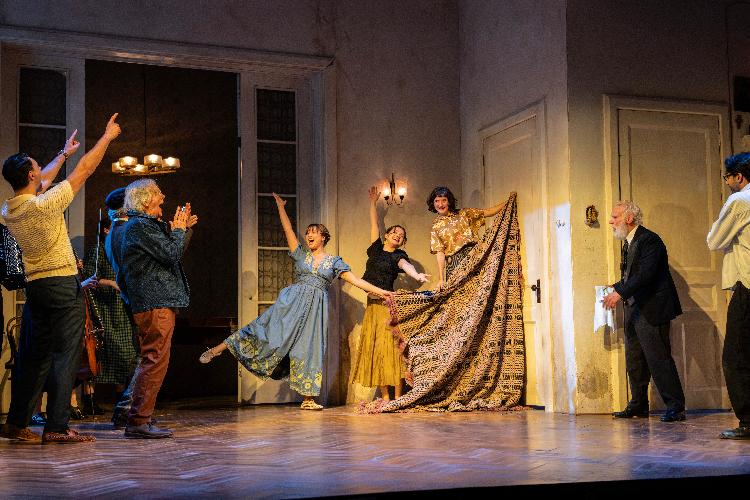
Led by the star pairing of Kristin Scott Thomas and Stephen Mangan, Anton Chekhov's final play, The Cherry Orchard, returns to the West End in a new adaptation by Conor McPherson, directed by Ian Rickson. McPherson brings a distinctly contemporary voice to the text, introducing colloquial language and a liberal sprinkling of swearing that gives the dialogue a more informal quality. Written in 1903, the play explores a family facing the loss of their ancestral estate and the cherry orchard that has been part of their lives for generations. It is a story of changing times, social upheaval and the inability of people to confront the realities of their circumstances.
At the centre of the story is Madame Ranevskaya, who returns to Russia from Paris to discover that her family estate is facing financial ruin. Yet rather than take decisive action, she and those around her continue to live in a world of memories, denial and wishful thinking. The characters are wonderfully self-absorbed, delusional, grieving and seemingly determined to bury their heads in the sand, even as everything around them is changing.
Kristin Scott Thomas is glorious as Ranevskaya. She has an almost luminous quality, effortlessly floating across the stage with a natural glamour and magnetic presence that makes it difficult to take your eyes off her. Her classist remarks and cutting quips are delivered with such a natural charm, and often forced smile, with seemingly little awareness of just how outrageous she is being. It is this effortless quality that makes her performance so compelling. You can understand why everyone around Madame remains so devoted to her, despite her many failings.
Stephen Mangan is equally well cast as Lopakhin, the former peasant turned successful businessman who is desperately trying to convince the family to take action before it is too late. Mangan brings an appealing, everyday likeability to the role, along with a social and physical awkwardness that reflects a man whose newfound wealth has not overcome his humble beginnings. Hopelessly in love with Ranevskaya, there is a particularly heartbreaking moment when Lopakhin seems on the verge of proposing to Varya, Ranevskaya's adopted daughter, but cannot quite bring himself to do so despite the audience willing him on. His lingering love for Ranevskaya seems to hold him back, with Mangan capturing the emotional conflict beautifully.
Anastasia Martin brings a lovely freshness to the role of Ranevskaya's daughter Anya, while Karl Johnson is excellent as Firs, the family's elderly servant. Johnson's performance is a particular highlight, providing a consistent and important presence throughout the piece, and a poignant connection to the world that is slowly disappearing.
It is an elegant-looking production, with Chloe Lamford's set creating an atmospheric backdrop to the family's declining fortunes. The play is set in the room of Ranevskaya's son Grisha who tragically drowned as a child aged seven. There are some lovely, thoughtful details, including height markings on the wall recording his childhood growth. Bruno Poet's lighting is excellent in capturing the changing light of day, with sunrises and sunsets through the windows creating some beautiful stage pictures and a strong sense of time passing.
Sussie Juhlin-Wallén's costumes are a blend of period and modern dress, with contemporary silhouettes complemented by Russian-inspired trims and braiding. The combination works well, establishing individual characters while retaining a connection to the play's historical and cultural setting.
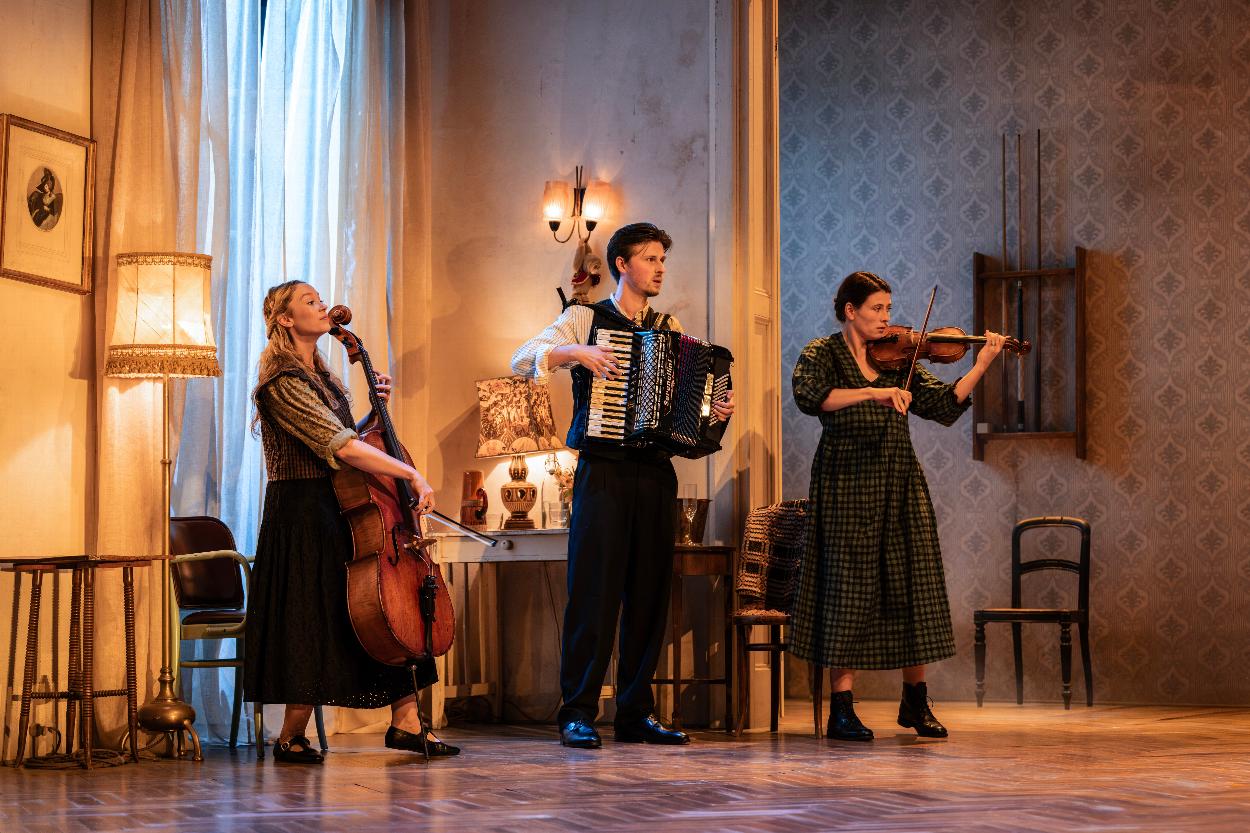
Music also plays an effective role in the production. Stephen Warbeck's score, alongside Tom Gibbons' sound design, adds texture to the scene changes, while live guitar contributes to the atmosphere. The music becomes more prominent at the beginning of Act Two, when a travelling band featuring an accordion and other instruments brings a welcome sense of life, energy and Russian culture to the stage. There is also some delightful entertainment from Ruby Bentall as Sharlotta, whose playful party tricks inject a welcome burst of humour and theatricality into the proceedings.
Where the production is less successful is in finding a consistent balance between comedy and drama. Chekhov himself regarded The Cherry Orchard as a comedy and given the absurdity of these characters and their circumstances, there is certainly plenty of humour to be found. However, Rickson's direction sometimes pushes the comedy so overtly that it moves into farce, losing some of the sting of the underlying drama.
At other times, the dialogue feels surprisingly flat. There is also a noticeable inconsistency in delivery across the cast, with some actors seeming to over-project and exaggerate their performances, while others adopt a more naturalistic approach. These contrasting styles don't always sit comfortably together, leaving the director's overall vision feeling somewhat uneven.
The challenge with The Cherry Orchard is that its humour and tragedy are so closely intertwined. These are characters who are often ridiculous, but they are also deeply human, struggling with grief, loss, love and the fear of change. The comedy is most effective when it emerges naturally from their behaviour, rather than being pushed for laughs.
Ultimately, this is a production with some wonderful individual performances, beautiful visual moments and an engaging central pairing. Scott Thomas is a delight to watch, and Mangan provides an appealing foil to her extravagance. Yet despite its many strengths, the production doesn't always find the consistency of tone needed to bring Chekhov's comedy and underlying tragedy together into a fully cohesive whole.
It runs until 9 January. Tickets: here.
Review: Lola Phillips Photos: Johan Persson